
AI Data Center Jobs Are Fueling the Next Infrastructure Revolution
- Apex Elite Team
- Jul 24
- 4 min read
Updated: Jul 29
AI transforms software. Yet the real race happens elsewhere. Look inside substations, switchgear rooms, mechanical plants, and hyperscale data centers.

Every AI breakthrough relies on physical infrastructure. These sites need massive power. They need advanced cooling. They need thousands of skilled engineers. Teams must design, build, commission, and operate every facility. Concrete, steel, and power distribution form the foundation of AI. For engineers and contractors, this creates a major career opportunity.
Executive Summary: Why AI Data Center Jobs Matter for Engineers
Massive Capital Deployment: Analysts project global investment will pass $3 trillion by 2030.
The Talent Bottleneck: Funding is not the main limit. Companies struggle to find electricians, commissioning engineers, MEP specialists, and site managers.
32% Salary Premium: Mission-critical construction roles pay far more than traditional construction jobs.
Build vs. Operate: Peak hiring occurs during the 18-36 month build phase. Construction needs up to six times more workers than daily operations.
AI Is an Infrastructure Revolution, Not a Software One
When ChatGPT launched, the world focused on software. Behind the scenes, tech leaders faced a physical problem. They needed raw power to run demanding AI models.
Better code could not fix this issue. The market needed physical assets.
AI cannot exist without data centers. Data centers cannot run without reliable power and precision cooling. At Apex Elite, we see this shift every day. Contractors across Europe and North America need data center specialists now.
Data proves this shift. Over the past year, hiring timelines for commissioning engineers doubled. Projects compete for the same small talent pool. Today, career growth is strongest in electrical engineering, cooling, commissioning, and site delivery.

The $3 Trillion Infrastructure Supercycle
A software trend has become a physical infrastructure race. Tech giants spend billions to build new capacity. Microsoft, Google, AWS, Meta, and Oracle lead the way.
Moody's reports total data center investment could pass $3 trillion in this cycle. JLL’s 2026 Global Data Center Outlook Outlook projects 100 new gigawatts of capacity by 2030. That doubles today's footprint. Synergy Research Group counted over 1,360 hyperscale facilities by late 2025. By 2031, hyperscale operators will control 67% of global capacity.
This physical growth needs specialized technical talent.
The Human Bottleneck Behind AI Data Center Infrastructure Jobs
Capital is not the main bottleneck for this industry. Companies lack access to experienced engineers who can run critical projects.
Talent shortages cause immediate delays. A missing commissioning engineer can stall a $500 million project. Only a certified engineer can energize the site. At Apex Elite, we see projects stall for one reason. Teams cannot find MEP or commissioning experts. Reports show a U.S. shortage of over 300,000 electricians.
Similar gaps hit commissioning teams, HVAC experts, and site managers across Europe.
Salary Premiums Are Rewriting the Rules
High demand drives pay up fast:
Base Premium: Data center specialists earn 32% more than traditional construction roles. That's $81,800 versus a $62,000 average U.S. construction salary.
Top Markets: Senior specialists earn $120,000 to $280,000+ in total pay. Top hubs include Northern Virginia, Texas, Frankfurt, and Dublin.
Perks: Offers often include $20k-$40k relocation packages and rotational shifts. Per diems and sign-on bonuses are common too.

The Workforce Paradox: Construction vs. Operations
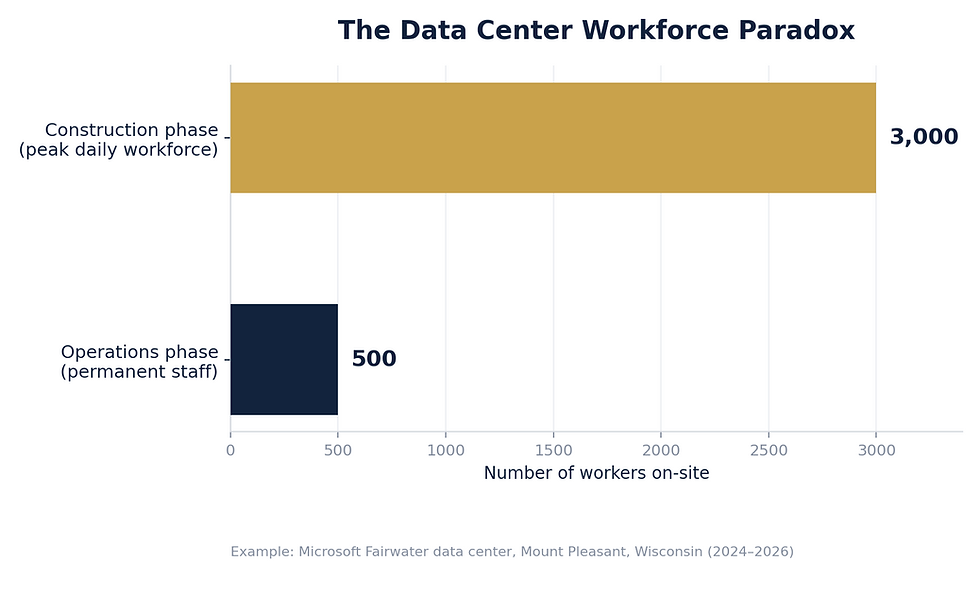
Data centers do not keep thousands of staff on-site long term. The main hiring wave happens during construction.
A hyperscale project needs 1,000 to 3,000 specialists over an 18- to 36-month build. Once the site goes live, most of those jobs disappear.
Case Study: Microsoft Fairwater Campus (Mount Pleasant, WI)
This $7.3 billion project needed over 3,000 workers per day during peak construction. Phase one opened in 2026. Permanent operational staff then dropped to 500-800 roles. That's a sixfold reduction.
Builders are launching hundreds of new developments worldwide. Hiring will center on construction, MEP coordination, and commissioning for years.
Most In-Demand Roles in Critical Infrastructure
Apex Elite places specialized technical talent across six main areas:
Electrical Infrastructure: High/Medium-Voltage Engineers, Power Infrastructure Specialists, Protection & Control Engineers.
Mechanical & Critical Systems: HVAC engineers, precision cooling specialists, chilled water systems.
Commissioning & Mission Critical: Commissioning Managers, Controls Engineers, QA/QC, testing & validation.
MEP & Digital Engineering: MEP coordinators, BIM managers, building services engineers.
Construction & Delivery: Project managers, site superintendents, and quantity surveyors.
Civil & Structural: CSA Engineers, Structural & Geotechnical Specialists.
FAQ
What are AI data center infrastructure jobs? These roles cover engineering and construction tasks. Specialists design, build, power, and cool the data centers that run AI hardware.
Why do data center engineers earn more than traditional construction workers? Technical complexity, strict uptime needs, and severe talent shortages push pay up. The premium tops 32%.
Which countries invest the most in AI data centers? The United States leads global investment. Centers cluster in Virginia, Texas, Arizona, and Ohio. Europe follows with FLAP-D hubs: Frankfurt, London, Amsterdam, Paris, and Dublin. New sites are also emerging in Spain and the Nordics.
Are AI data center infrastructure jobs future-proof? Yes. Physical infrastructure needs hands-on site work, high-voltage testing, and HVAC validation. AI software cannot replace these physical engineering skills.
What qualifications do candidates need? Most roles need an engineering degree in electrical, mechanical, or civil. A trade certification also works. Employers also value hands-on experience in power, cooling, BIM modelling, or site management.
Partner with Apex Elite
Companies with the best ideas will not win the AI race. Teams that build the physical infrastructure will win. That mission needs the right people.
Apex Elite connects top engineers with hyperscale builders. We skip high-volume recruitment. Instead, we build long-term partnerships. We connect technical experts with world-class organizations.
Looking for your next data center role? Explore roles in commissioning, MEP, electrical engineering, and project delivery.
Building a hyperscale team? Partner with Apex Elite to secure proven engineering talent for mission-critical projects.



Comments